i like john dawes' hypothesis best, as i can indeed 'not record the tones i hear' because they're mechanical not sonic aka 'gravity waves' byproduct of how the electric grid interacts with the lightning-charged ionosphere and for whatever reason only some 2-4% hear it.
March 2nd, 2018 · 92 Comments · Health
In 2012, I made a Web-based tone generator with the goal of helping tinnitus patients determine the frequency of their tinnitus to better target therapy. Since then, I have heard from people using my generator to teach physics, practice violin, drive away carpenter bees, tune DIY speakers, analyze room acoustics, calibrate vintage synthesizers, cause mischief in class with frequencies the teacher can't hear, and even open a portal to Sedona, AZ. Far be it from me to take away from all these worthwhile applications, but last week, I got a message from Dennis Tuffin (of Devon, England), describing a new use for my generator which may very well trump everything else:
For the past 7 weeks I have been using your tone-generator for a purpose I wouldn't think you had envisaged but about which I am sure you will be interested.
I have been following up on some research which my daughters had done about the treatment of Alzheimers by using a 40Hz flickering light source or alternatively a 40Hz sound source. There is sparse info on the net about these experiments though there is a recent piece about it. [here Dennis is referring to this paywalled article]
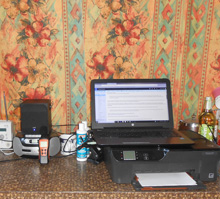
So I have been trying the sound therapy on my wife who is in the advanced stages of Alzheimer's and to my surprise after 8 days she started to show small signs of being more mentally alert than before. So I have continued to use your tone generator using a 40Hz sine wave for about an hour each day. (I've recently started to do it twice a day for slightly shorter sessions). I found it necessary to connect external speakers to my laptop in order to pick up such a low note and to run it at a level of between 46-54 decibels so that she hears it wherever she is in the room. (Dementia sufferers get very fidgety!).
So now 7 weeks on the improvement in her awareness has continued to the point where she is starting to be able to put a few words together and to respond to questions neither of which she has been able to do for nearly a year. Her odd physical habits have not been changed so far but she is definitely walking better and not shuffling her feet as she used to. Surprisingly, she is also sleeping better and not suffering as much with the sleep apnoea problem that she's always had.
The setup used by Dennis. The black box on the left is the external speaker.
Of course I expect there to be a limit to this progress as in the 8 years since my wife was first diagnosed her brain will have shrunk considerably so I do not expect her memory to return but on the other hand my wife's quality of life has been improved.
To date I have not gone public on this and only close family have known but by the end of another week when it will be 8 weeks since we started I think I would like to spread the word and hopefully prompt a few professionals to do more proper research.
THE SCIENCE SO FAR
- It has been known since at least the 1980s that cognitive activity triggers brainwaves (wave-like patterns of activation) at a frequency of 40 Hz in humans and other mammals.
- In 1991, researchers from the NYU Medical Center discovered that Alzheimer's patients have reduced 40 Hz brainwaves compared with healthy people. (paywalled paper)
- In 2016, MIT's Alzheimer's group did experiments on transgenic mice with early Alzheimer's disease and found that exposing them to a light flickering at a frequency of 40 Hz (40 times a second) for 1 hour a day for 7 days causes an almost 60% reduction in β-amyloid plaques, which are a molecular hallmark of Alzheimer's. Flickering at 20 Hz and 80 Hz did not have the same effect. An important qualification here is that the effect was limited to the visual cortex, which is not significantly affected in human Alzheimer's patients. Here's an accessibly written report in The Atlantic and here's the original paper (published in Nature) if you're strong in science-speak. MIT also made a video about the findings.
- In March 2016, scientists at the University of Toronto published the results of a small, placebo-controlled pilot study (paywalled paper), in which they exposed 20 Alzheimer's patients to a 40 Hz sound. After six 30-minute sessions (done twice a week), the patients' average score on the 30-point SLUMS scale improved by 4 points, while the placebo group did not improve. It should be noted that the "dosage" of the treatment was rather low, which may explain the modest results.
- In January 2017, Cognito Therapeutics, a company formed by some of the members of the MIT team, started conducting preliminary trials to assess the safety of exposing AD patients to simultaneous flickering lights, an audio tone, and vibrations – all at 40 hertz.
- In January 2018, the New Scientist reported (paywalled article) that the same MIT team achieved even better results by playing mice a 40 Hz sound. β-amyloid plaques shrank by about 50% in the auditory cortex and – crucially – in the hippocampus, perhaps because the two areas are close to each other. This would be a very important discovery, because the hippocampus is the region of the brain which is involved in forming memories. It is the hippocampus that suffers the most damage in human Alzheimer's patients. According to the magazine, these results were presented at the Society for Neuroscience conference in Washington in November 2017. However, the published paper described a significantly different protocol (see below), so it is likely that the New Scientist didn't get the details right.
- In July 2018, the International Journal of Alzheimer's Disease published the results of a pilot study in which 6 human patients were exposed to a 40-hertz flickering light bulb for 2 hours a day for 10 days. The therapy was administered in a home setting by the patients' caregivers. No difference in β-amyloid plaque was found after therapy. If there was an effect, it must have been smaller than 20%, which is not comparable to the 50% reduction seen in mice.
- In March 2019, Cell published another (paywalled) paper about another study done by the MIT group. Here's a NYT article about it. Here are the main points:
- After mice were exposed (for 7 days, 1 hour a day) to a series of clicks repeating at a frequency of 40 Hz, the amount of amyloid plaque in their auditory cortex and their hippocampus was reduced by about 40%. The mice also did better on several tasks involving the use of memory.
- The clicks were 10 kHz waves, 1 millisecond long, repeated 40 times a second (each cycle had a 1 ms tone followed by 24 ms of silence). In communication with me, one of the paper's authors said that pure 40 Hz tones were not used because mice cannot hear tones of such a low frequency.
- When this auditory treatment was combined with light pulses at 40 Hz, microglia ("brain cleaner cells") started clustering around amyloid plaque, and the reductions in plaque extended to parts of the prefrontal cortex (an area related to functions like attention and short-term memory). This effect was not observed with either audio or light treatment alone.
- Cognito Therapeutics are now conducting three clinical trials, the first of which is expected to complete by October 2019 (although publication of results could come much later). It is unknown what kind of tones are being used.
FURTHER READING/LISTENING
- Good overview from Nature magazine (March 2018)
- Podcast on gamma brainwaves from Radiolab (this one's from late 2016 and doesn't include the latest research)
(DON'T) TRY THIS AT HOME
If you want to try some kind of do-it-yourself auditory therapy, it's not clear what kind of tones you should use. Dennis, the reader from the UK who piqued my interest in this subject, used a pure 40 Hz tone. According to this AlterNet article (later reprinted by The Salon), a pure tone was used in the preliminary safety study done by Cognito in early 2017. On the other hand, it appears that the most recently published MIT study used series of clicks (despite previous reports) rather than a tone. The New York Times quotes Dr. Tsai, who worked on that study, as saying "your brain seems to be able to perceive clicks more than a tone", which would seem to indicate a preference that's not exclusive to mice.
However, in response to my inquiry, another co-author of the paper, Ho-Jun Suk, said that 40 Hz pure tones were not used because mice cannot hear tones of such a low frequency. It would be very interesting to know what sort of tones are being used in the now ongoing human trials. (If you are in the trials or know anyone who's in them, please let everyone know in the comments section.)
The New York Times and the Boston Globe published articles about the MIT mice study, including links to audio samples of the stimuli that were used by the researchers. Unfortunately, I have discovered that neither sample represents accurately the audio waves that were played to the mice. The clicks in the published samples are smeared in time (closer to 2 ms) and are not pure 10 kHz tones. Ho-Jun Suk has confirmed that they do not match the source signal. (I don't know how the NYT and Boston Globe managed to mangle the files so badly, but it's not because of compression – I tried it on the same encoder and the same parameters that were used by the NYT and it did not distort the signal very much at all.)
If you are thinking about using clicks rather than pure tones, I would not recommend using 10 kHz clicks because human ears are not very sensitive to that range of the spectrum. Something like 3 kHz (where human hearing works the best) would probably be more sensible.
TECHNICAL ADVICE FOR PLAYING PURE 40 HZ TONES
If you want to try playing a 40 Hz tone (rather than a series of clicks) to someone with Alzheimer's, here's some technical advice:
Getting a 40 Hz tone is easy – you can use my frequency generator. (Please note I do not take responsibility for the purity of the produced tone, as it is generated by your Web browser – though I think it should be fine. By the way, I am also not a doctor and I am not giving medical advice or offering any medical product here.)
You will need decent speakers. 40 Hz is a very deep bass tone – the kind of rumbling tone that you feel in your body as much as you hear it. Small speakers, such as laptop speakers or small computer speakers, don't go that low. If you try anyway, you will either hear nothing, or you will hear mostly – or only – distortion. What is distortion? It's a higher-pitched, buzzing noise that speakers make when you push them too hard.
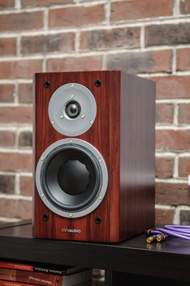
A bookshelf speaker (photo: D. Cedler)
Bookshelf speakers will do 40 Hz, but their output at that frequency will be significantly reduced, so you will need to turn up the volume significantly, and they will produce easily audible distortion. Because the ear is more sensitive to high frequencies, the distortion may be subjectively louder than the fundamental 40 Hz tone, and may make the sound harder to tolerate, thus limiting the volume (and possibly the therapeutic effect).
The best solution is a high-quality subwoofer. It won't be distortion-free, but you can expect the distortion to be 2–3 times quieter than with bookshelf speakers. This will give you as pure a tone as you can get. If you don't care about playing music, you can get just a subwoofer (without any other speakers) and connect it to your computer or mobile device.
A neat trick to amplify the bass output of any speaker is to place it against as many walls as possible. For the maximum boost, put the speaker(s) on the floor, in a 3-way corner between two walls and the floor – that way, it will be adjacent to three surfaces.
How important is sound quality? It's hard to say. Dennis seems to have had great results with cheap computer speakers. It is not known to what extent the therapeutic effect depends on volume or the presence of distortion. On the other hand, if you use small speakers, it won't be obvious whether they're actually playing 40 Hz or just distortion – so it's worth getting something bigger just to be on the safe side.
Can you use headphones instead? It's hard to say with certainty, as a 40 Hz tone played through your speakers will not just be heard with your ears – it will also be felt in your whole body. With headphones, the effect is strictly auditory. However, so far I haven't seen any specific scientific reasons to suggest that this difference is important, and in fact headphones were used in the initial safety studies commissioned by Cognito. If you decide to use headphones, make sure they can do 40 Hz. The earbuds that came with your smartphone are probably not the way to go here. HeadRoom has a database of frequency response graphs for high-quality headphones, so you can check how loud a given model is at 40 Hz. Want a specific recommendation? Get the Koss Porta Pros (Amazon.com, Amazon.co.uk). They'll do the job, they're the most comfortable headphones I've used, and – at $40 – they're tremendous value.
CALL FOR COMMENTS
If you or your loved one has Alzheimer's disease and you have tried 40 Hz sound therapy, please share your experiences – whether positive or negative – in the comments section below.
92 COMMENTS SO FAR
my sessions run 15 to 30 minutes, several times per week. My memory seems to be improving, subtly. Here's hoping.
-- mark
Next to training the brain to have more capacity, training for more gamma waves specifically would also be an option. This training is permanent and much much stronger then just audio signals. In my first session my 33 year old brain brain could only handle 14 minutes 🙂
Then also to bring this on everyone's radar, the Bredeson protocol seems to be very promosing in treating alzheimer. It regards and treats Alzheimer as a muli-factor lifestyle disease – with the ketoflex diet being the most important intervention.
very intriguing to me and wondering if there are known benefits playing 40Hz beyond improving the effects of Alzheimer's. Is/are there potential benefits or risks to healthy individuals?
For best results, use tone that are easily audible and below 1000 Hz. Most research has been done with headphones, playing one tone in one hear and the other tone in the other ear, but it is not clear that that is necessary, as effects can be observed just listening to the tones playing together on a normal stereo without headphones.
Google "Binaural Beats" for a lot more information.
I am currently 'testing' on my father-in-law, after 1 week of 1 hour a day sessions he and others have noticed improvements. He is no longer sleeping during the day and his mood has improved, he seems more alert. We will continue to test the device on him.
If anyone is interested in a device, I can make them to order (UK).

Scientists eager to explain brain rhythm boost's broad impact in Alzheimer's models
RESEARCH FINDINGS
In three papers, including two this year in Cell and Neuron, they've demonstrated that exposing mice to light flickering or sound buzzing at 40Hz, a method dubbed "GENUS" for Gamma ENtrainment Using Sensory stimuli, strengthens the rhythm across the brain and changes the gene expression and activity of multiple brain cell types. Pathological amyloid and tau protein buildups decline, neurons and their circuit connections are protected from degeneration and learning and memory endure significantly better than in disease model mice who do not receive GENUS.
In a new review article in Trends in Neurosciences two researchers leading those efforts lay out the few knowns and many unknowns that must be understood to determine how the widespread effects take place. It's a challenge they relish because the answers could both break new scientific ground and help them improve how GENUS could become a therapeutic or preventative approach for people.
...

No comments:
Post a Comment